

Summary Statement
Article offers a brief guide to the types of available respirators as classified by NIOSH and which hazards each is designed to address.
New classifications help match protection to hazard
In the United States, NIOSH (the National Institute for Occupational Safety and Health) introduced new requirements for particulate filters in 1998. The new rules upgrade the respirator filters in use, providing better protection against all sizes of particles in the workplace. NIOSH has exclusive authority to certify most respirators. NIOSH standards are referenced in Canadian codes and regulations.
Oil droplets in the air have been found to ruin the filtering ability of some filter material. To ensure that a suitable filter is being used, particulate filters now have an N, R, or P designation (Not resistant to oil, Resistant to oil and oil-Proof). R or P filters should be used when oil is present.
Previously the particulate filters used on air-purifying respirators were broken down into dust/mist, dust/mist/fume, and HEPA cartridges. Now non-powered air-purifying particulate filters are divided into three levels of efficiency (95%, 99% and 99.97%). All three of the new filters will outperform the dust/mist and the dust/mist/fume filters used in the past.
The N series of filters (Not resistant to oil) is appropriate for all airborne solids (particulate) when there are no oil-based products also in the air.
The R series (Resistant to oil) should only be used for an 8-hour shift when solvent or oil mist is present in the air. This filter resists oil but may break down in contact with oil or solvent over a long time.
When using P series filters (oil-Proof), check the manufacturer's recommended service life to determine how long the filter can be used when oil aerosols are present.
Respirator
Filters for Non-powered Air-purifying Respirators
New
Classification System
Old
Classification System
Filter
Class/Efficiency
Resistance
to Oil
Filter
Class/Efficiency
Resistance
to Oil
95
(95% efficient
at 0.3 um)
Superior to old dust/mist and old dust/mist/fume in efficiency
Three
Types
N
= Not Resistant to oil
R = Resistant to oil
P = Oil Proof
Dust/Mist
Dust/Mist/Fume
No standard
or classification
99
(99%
efficient at 0.3 um)
Three
Types
N
= Not Resistant to oil
R = Resistant to oil
P = Oil Proof
There
was no filter in this range
There
was no filter in this range
100*
(99.97%
efficient
at 0.3 um)
Same as HEPA
*Only
P100 can be colored magenta/purple
Three
Types
N
= Not Resistant to oil
R = Resistant to oil
P = Oil Proof
HEPA**
(99.97% Efficient
at 0.3 µm)
**Colored
magenta/purple
No standard
or classification
|
|
||||
|
|
|||
|
|
|
|
|
|
|
(95% efficient at 0.3 um) Superior to old dust/mist and old dust/mist/fume in efficiency |
R = Resistant to oil P = Oil Proof |
|
|
|
|
|
R = Resistant to oil P = Oil Proof |
|
|
|
|
at 0.3 um) Same as HEPA
|
R = Resistant to oil P = Oil Proof |
(99.97% Efficient at 0.3 µm)
|
|
|
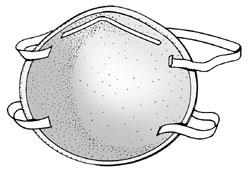 Filtering
Face Piece
Filtering
Face Piece
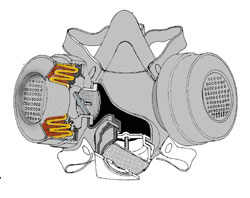
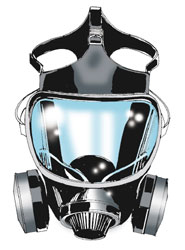
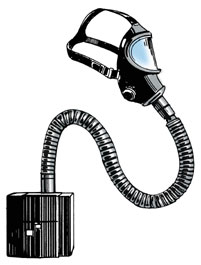 Powered
Air-Purifying Respirator(PAPR)
Powered
Air-Purifying Respirator(PAPR)
Guidelines for typical activities
The following table
lists some common construction activities and suggests respiratory protection
that should provide adequate protection in most circumstances. In several
cases more than one recommendation is given. Every situation is different.
Factors such as the amount of ventilation, degree of enclosure, duration
of exposure, specific work activity, other contaminants in the area, and
user characteristics can all affect respirator selection. Please contact
your respirator manufacturer or CSAO if you are unsure about the selection
of a respirator for a specific task.
View Chart 1(Respirator Selection Guide for Common Construction Activities)
View Chart 2 (Respirator Selection Guide for Common Construction Activities)
