

Summary Statement
Describes a program where colored stickers are placed on heavy equipment to indicate how loud the equipment is and whether hearing protection is needed. Includes information on selection of protection.
June 2004
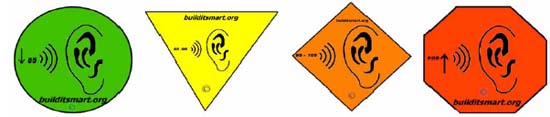
On five large construction sites in Washington state, colored stickers are starting to appear on heavy equipment. Each sticker - green, yellow, orange, or red, with a sketch of an ear and a number on it - tells how noisy the equipment is. Green is OK, less than about 85 decibels; red is the noisiest.
The system has been developed by Build It Smart, the Building Trades Labor- Management Organization of Washington State, with input from contractor safety staff, unions, and others. The goal is to show site owners, supervisors, and workers where changes are needed to protect workers' hearing.Scientists have demonstrated that most construction workers suffer substantial hearing loss, which probably is related to noise on the job, although there is not a federal noise standard for construction. In Washington state, which compensates workers in all industries for work-related hearing loss, the rate of hearing loss claims in construction was about 5 times higher than the all-industry average (in 1997-98), said William Daniell, MD, of the University of Washington. Claims were particularly high in road construction, with only logging having a higher rate.
Hearing loss means workers may be at increased risk on the job, if they can't hear warnings and traffic. They lose quality of life away from work, if they can't share conversations or even listen to entertainment.
Noise levels are measured in decibels. We talk at about 70 decibels. (Decibels are like earthquake measurements, so 73 is twice as loud as 70.) OSHA regulations say it's safe to work for 8 hours at 90 decibels without hearing protection, but many experts say that level is too high. Examples of noise levels measured around construction equipment are 102-110 for a jackhammer, 88-102 for a portable saw, and 93-96 for a bulldozer.
In Washington, contractors are required to identify hazardous noise levels and noise levels can be measured using $50 sound meters available at electronics stores. But there can be dozens of pieces of equipment on a work site and the noise levels change, depending on what a machine is doing and how close a worker is to it. So with support from OSHA and CPWR – Center for Construction Research and Training, Build It Smart is trying this new system.
It includes training and information about ways to change (or move or block with a barrier) equipment or use personal protective equipment (PPE) to protect workers. A computerized directory will show pictures of workers using equipment with labels showing usual noise levels.
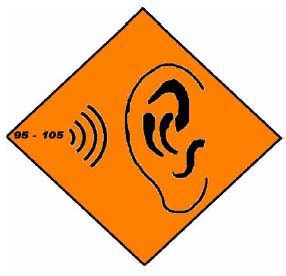
The noise categories are: green circle (safe), less than 85dBA; yellow triangle (caution), 85 - 95; orange square (hazard), 95 - 105; and red octagon (danger), higher than 105. Each label will be available in three sizes, ranging from hardhat decal size to poster size. For more information, call 360-596-9200 or builditsmart@qwest.net
Noise Checklist
Noise Levels (dBA)
|
|
w/o barriers |
w /plywood barrier |
w/ raised plywood barrier |
||||||||||||
Tool/ Equipment |
Task performed |
@ ear |
@ 5' |
@ 10' |
@ 20' |
@ 40' |
@ ear |
@ 5' |
@ 10' |
@ 20' |
@ 40' |
@ ear |
@ 5' |
@ 10' |
@ 20' |
@ 40' |
Worm Drive Circular Saw
|
Cutting 28 ga sheeting w/ reversed conventional Blade |
112
|
109
|
102
|
99
|
93
|
112
|
97
|
92
|
88
|
81
|
112
|
93
|
89
|
83
|
79
|
Worm Drive Circular Saw
|
Cutting 28ga sheeting w/ Abrasive Blade |
104
|
96
|
91
|
85
|
79
|
104
|
79
|
73
|
70
|
65
|
104
|
85
|
81
|
75
|
71
|
Worm Drive Circular Saw* |
Cutting Fir 2x6 w/Dull Conventional Blade |
107 |
99 |
93 |
87 |
81 |
107 |
82 |
76 |
73 |
68 |
107 |
88 |
84 |
78 |
74 |
Worm Drive Circular Saw* |
Cutting Fir 2x6 w/sharp Carbide Blade |
95 |
87 |
81 |
75 |
69 |
95 |
70 |
64 |
61 |
56 |
95 |
76 |
72 |
66 |
62 |
PortaBand |
Cutting 22ga 6" metal |
104 |
96 |
91 |
85 |
79 |
104 |
79 |
73 |
70 |
65 |
104 |
85 |
81 |
75 |
71 |
4" Angle Grinder |
Grinding Light Gauge |
103 |
100 |
95 |
90 |
84 |
103 |
80 |
74 |
70 |
64 |
103 |
84 |
80 |
74 |
70 |
Sawzall |
Cutting 22ga 6" Metal Stud |
103 |
98 |
92 |
85 |
80 |
102 |
87 |
81 |
76 |
70 |
102 |
83 |
79 |
73 |
69 |
Shop Vac |
Working Mode |
|
88 |
82 |
77 |
72 |
|
|
|
|
|
|
|
|
|
|
Shop Vac (by wall)** |
|
|
90 |
85 |
79 |
73 |
|
|
|
|
|
|
|
|
|
|
* The sharp carbide blade made the cut about 4 times faster than the dull conventional blade
** Shop Vac was set up 2' from a long, tall, and solid wall under an 8' high fiberglass overhang extending outward about 4'.
Measured background noise from nearby (Approx 200 yds) highway traffic ranged from 64-75 dBA
Source: Build It Smart, April, 2001
Location: Ironworkers Training Center Outside Field Activities
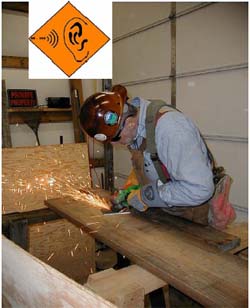
4 Inch Electric Disk Grinder 101
HEARING PROTECTION SELECTION
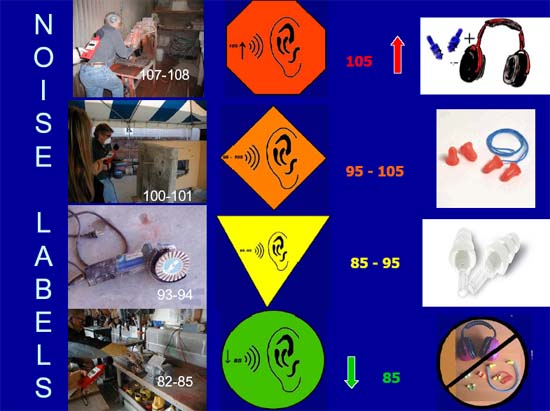
*The hearing protection shown above should be used as merely guidelines. Individual selection with comfort and convenience are the highest predictors of regular usage.
