

Summary Statement
Provides data on the financial benefits of improving safety with information on direct and indirect costs of injuries and illnesses.
Nov 2001
|
The
average WSIB cost of
one lost-time injury is $35,000. |
In many cases, contractors consider health and safety a legal requirement that means spending money without any hope of profit.
But a quick look at the cost of workplace injuries and the potential return on investing in accident prevention shows that a safe, healthy workplace can be a profit centre.
Direct and indirect costsInjury costs are subtracted from a contractor's bottom-line profit. These costs can't be depreciated, written off as business losses, or deducted as expenses.
To offset $50,000 in losses from injuries, illnesses, or damage and still make a 3% profit, a company must sell an additional $1,667,000 in services.
Injuries involve both direct costs and indirect costs. Direct costs consist of
- medical expenses such as ambulance, hospital, and doctors' fees, medication, and rehabilitation
- compensation payments
- Workplace Safety and Insurance Board (WSIB) premium increases
- litigation costs.
The average WSIB cost of one lost-time injury in construction is $35,000. In most cases, direct costs are covered by the WSIB and therefore have little or no immediate impact on profits. But they do impact on future profits, since they drive up the cost of doing business.
Indirect costs include disrupted work schedules, lost productivity, clean-up and repair, hiring and training replacement workers, bad publicity, and time spent on accident investigation, claims management, and litigation.
CSAO has found that the average ratio of indirect to direct costs in Ontario construction is 5 to 1. Indirect costs exert an immediate impact and usually result in lost profits.
ResearchRecent studies indicate that investing in health and safety can yield financial advantages. Some highlights:
- Accident prevention can be improved without higher costs and slower schedules.
- Workplace injuries account for 6-9% of project costs whereas an effective health and safety program accounts for only 2.5% of those costs.
- The higher the safety investment in a project, the lower the injury rates and the higher the profit.
- Increased training, more frequent inspections, and more health and safety meetings with field supervisors result in fewer lost-time injuries, lower costs, and a larger profit margin.
- CSAO found that construction workers with back injuries who participate in a back care program are less likely to be re-injured than those who don't participate.
Too often, contractors are reluctant to invest in health and safety because of limited resources or because they don't realize the potential benefit to both the workforce and the company.
The investment naturally costs money in the short run but in the long run it can save lives, reduce injuries, and increase profit.
This can be vital to a contractor's financial health during bust as well as boom times.
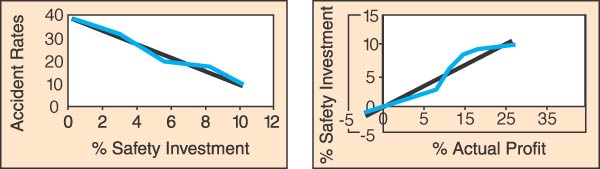
Graphs
reproduced from A.J. Joseph, "Safety costs money and can save money" in
Singh, Hinze, and Coble (editors),
Implementation of Health and Safety on Construction Sites, 1999
