

Summary Statement
Provides a basic understanding of the nature of noise exposure in construction and details on how to set up a hearing conservation program to minimize hearing loss.
Autumn, 2000
How to prevent noise-induced hearing loss in construction
Introduction
Noise exposure is one of the most widespread health hazards in construction. Each year in Ontario there are about 300 new compensation claims for noise-induced hearing loss (NIHL) in the industry. NIHL can and should be prevented.
Prolonged exposure to noise over the years generally causes permanent damage to the inner ear that can't be repaired medically or surgically. Because NIHL is usually gradual, impairment isn't noticed until a substantial degree of hearing loss has already occurred. The occupational and personal consequences are significant:
- Workers with NIHL may not hear audible warnings and safety signals.
- Hearing impairment jeopardizes not only affected employees but others who work with them.
- NIHL may interfere with daily life, especially during social activities in noisy settings.
- The increased effort to listen and understand may lead to fatigue, anxiety, and stress.
- Those affected may feel increasingly isolated from family and friends.
- Some people with NIHL also suffer from tinnitus, causing them to hear ringing, buzzing, rushing, whistling, or hissing when there are in fact no sounds to be heard.
This article documents the noise levels found on construction sites, indicates the extent of hearing loss among construction workers, and recommends how the industry can help prevent NIHL.
Sound and HearingSound stimulates tiny hair-like cells in your inner ear. These vibrate and send auditory messages to your brain. But too much noise for too long can damage the cells. When they no longer send signals to the brain, hearing is lost. Damage often occurs slowly over a number of years and may go unobserved until too late. Most of the workplace sounds that cause permanent damage occur over a long time (for example, about 8 hours per workday over 10 years or more).
Sound is defined by strength, frequency (pitch), and duration.
Decibel (dB) is the unit used to measure a sound's strength. The decibel scale is not linear but logarithmic. This means that noise levels can't be added directly like other numbers. For example, a backhoe and a compressor each producing 90 dB have a combined output of 93 dB, not 180. But 93 dB is still twice as much noise as 90 dB. In other words, sound intensity doubles every 3 dB.
Sounds must also be specified in terms of frequency or pitch. Most workplace noises include a wide band of frequencies and are measured through the "A" filter in sound-level meters. The noise level is therefore expressed in decibels (dB) on the "A" scale, or dB(A).
Duration of exposure is equally important. Duration is typically measured over a workday and accumulated through many years.
NoiseA noise level of 85 dB(A) over an 8-hour workday is potentially damaging. The louder the noise, the faster the damage. Remember that sound intensity doubles every 3 dB. So for each 3 dB increase in sound level, potential damage to the ear doubles. Noise exposure must be controlled accordingly.
|
Maximum
permitted daily duration in hours
|
Decibels
(increasing in units of 3) |
|
8
|
85
|
|
4
|
88
|
|
2
|
91
|
|
1
|
94
|
|
1/2
|
97
|
|
1/4
|
100
|
These guidelines are legislated in some jurisdictions across North America. But there are no standards for noise on construction sites in Ontario.
When considering sounds that can damage hearing, keep one important point in mind. What matters is the energy of the sound reaching the ear, not its source. In other words, it makes no difference whether the sound is made by a bulldozer or an orchestra.
Construction NoiseBy conducting sound surveys, CSAO has identified the construction trades and activities most likely to expose workers to hazardous noise.
Most trades are typically exposed to noise levels greater than 85 dB(A) averaged over an 8-hour shift.
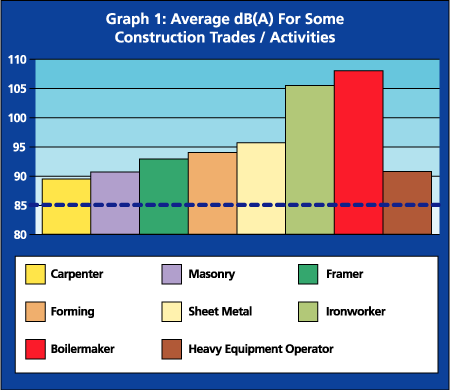
Graph 1 summarizes sound levels for the noisiest trades and work environments. With average exposures over 95 dB(A), boilermakers, sheet metal workers, and ironworkers are at significant risk of NIHL if not properly protected.
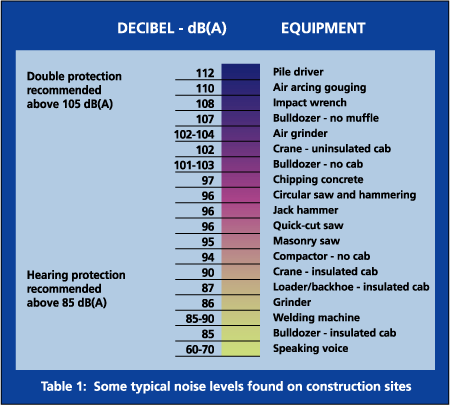
Table
1 shows noise levels measured for various types of tools and equipment
found on construction sites.
Audiometric Testing
Hearing loss is measured by determining the lowest level at which a person can hear at various frequencies. The first audiometric sign of NIHL is usually a loss of sensitivity in the higher frequencies from 3,000 Hz through 6,000 Hz. Permanent hearing loss results if exposure continues on a regular basis. As hearing loss spreads to higher frequencies, important speech information can become muffled and difficult to understand.
Audiometric testing has shown significant NIHL in 49% of British Columbia construction workers tested and 50% of Alberta boilermakers with 20 or more years' experience.
PreventionA hearing conservation program for construction must include the following components:
- sound surveys to assess the degree of hazardous noise exposure
- engineering and administrative controls to reduce exposures
- training in why and how to prevent hearing loss
- hearing protection (earplugs, earmuffs, and canal caps) to reduce sound reaching the ear
- audiometric evaluations to detect hearing changes.
To identify a noise problem and determine whether a sound survey is necessary, some basic questions need to be answered.
- Is the sound appreciably louder than conversational level?
- Does it continue for more than a few minutes?
- Is it difficult for you to follow a conversation in the area?
- Do you experience tinnitus (ringing in the ear) after you leave the area?
- Do sounds seem muffled after you leave the area?
If it's decided that a sound survey is necessary, ensure that the person conducting the assessment is thoroughly familiar with the operation, calibration, and limitations of the meters used.
Administrative controls may include the following measures.
- Employ quiet work practices such as using rubber mallets to erect and dismantle formwork.
- Use quiet construction equipment such as silenced compressors.
- Plan sites so that noisy operations are located away from personnel not directly involved. Or schedule noisy operations before or after hours to minimize exposure to other personnel.
- Calculate a noise perimeter zone where only designated workers are allowed to enter.
- Around noisy tools and equipment, post signs indicating that hearing protection must be worn.
- When orienting new employees and subcontractors, include information on noise levels, noise controls, and the selection, care, and use of personal hearing protectors.
- Rotate workers through noisy operations or areas to minimize exposure times.
Engineered noise controls include
- portable barriers around noisy stationary equipment like generators and compressors
- the use and regular maintenance of mufflers or silencers on noisy equipment
- periodic inspection and maintenance to make sure that equipment is in good order and running properly.
Training helps to ensure that the risks of noise exposure are understood and that exposed workers are not only instructed but also motivated to use hearing protectors conscientiously.
Personal hearing protectors are barriers that reduce the amount of noise entering the ear. The devices are either insert or muff types. The insert type attenuates noise by plugging the ear canal. The muff type covers the external ear and provides an "acoustical seal."
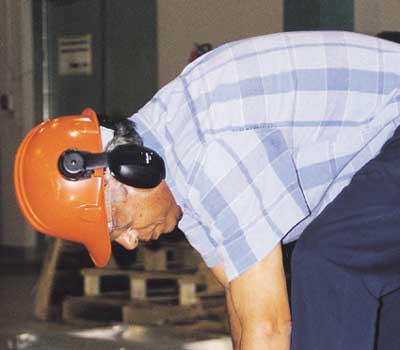
The Noise Reduction Rate (NNR) for a particular device is identified on its packaging. The NNR is an important consideration in choosing hearing protectors. To attain maximum rated protection, devices must be worn according to manufacturers' instructions. Again, training is essential.
For exposure levels over 105 dB(A), double protection may be required, that is, earmuffs and earplugs. At the other extreme, it's important to avoid overprotection. Using more protection than necessary can make workers feel isolated from their work environment. Take care to select protectors with sufficient, but not excessive, attenuation to keep noise below the safe limit of 85 dB(A).
Individuals exposed to noise in excess of 85 dB(A) averaged over an 8-hour shift should undergo periodic audiometric testing to determine whether they are developing NIHL. Anyone showing a significant deterioration in hearing compared to previous tests should be referred for a thorough medical examination.
|
Remember Although construction sites can be very noisy, an effective hearing conservation program will reduce or eliminate the risks of noise-induced hearing loss on the job. |
